
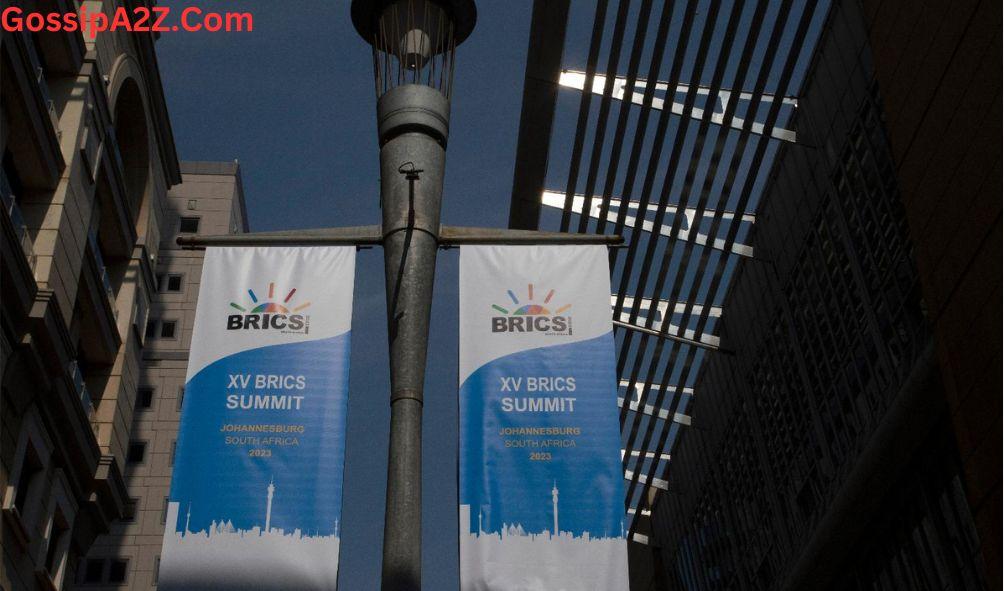
BRICS Summit: Russia & China Drive Agendas of developing countries in South Africa
Russia and China will seek to gain more political and economic footing in the developing world at a summit in South Africa this week, where a formal move to bring Saudi Arabia closer may give their anti-Western grumbling a sharper edge.
Leaders from the BRICS economic bloc of Brazil, Russia, India, China, and South Africa will hold three days of meetings in Sandton, Johannesburg’s financial district, with the presence of Chinese Premier Xi Jinping highlighting the diplomatic capital his country has invested in the bloc over the last decade and a half as a vehicle for its ambitions.
As a result of a warrant issued by the International Criminal Court for his arrest about the conflict in Ukraine, Russian President Vladimir Putin’s travel to South Africa has been complicated. Xi will be joined at the summit by Brazilian President Luiz Inácio Lula da Silva, Indian Prime Minister Narendra Modi, and South African President Cyril Ramaphosa.
The main summit on Wednesday, as well as the side meetings on Tuesday and Thursday, are anticipated to produce general demands for greater cooperation among countries in the Global South in light of their growing discontent with what they perceive to be Western dominance of global institutions.
Russia and China are more than glad to embrace this viewpoint. To give Xi and Russian Foreign Minister Sergey Lavrov, who will represent Putin in South Africa, a sizable audience, leaders or representatives of dozens more developing nations are expected to attend peripheral meetings in Africa’s wealthiest city.
The proposed expansion of the BRICS bloc, which was established in 2009 by the emergent market nations of Brazil, Russia, India, and China, with the addition of South Africa the following year, will be discussed and possibly decided upon.
Saudi Arabia is among the more than 20 nations that have formally applied to join BRICS, according to South African officials. Any move toward including the world’s second-largest oil producer in an economic bloc with Russia and China would undoubtedly attract the attention of the United States and its allies in a geopolitically frosty environment and in the wake of a recent Chinese initiative to exert influence in the Persian Gulf.
“If Saudi Arabia were to join BRICS, it would give this organization extraordinary significance,” said Talmiz Ahmad, India’s former ambassador to Saudi Arabia.
Analysts say that even an agreement on the principle of expanding BRICS, which already includes a significant portion of the developing world’s largest economies, would be a moral victory for the Russian and Chinese vision of the bloc as a counterbalance to the G-7.
Amid China’s economic friction with the U.S. and Russia’s Cold War-like impasse with the West over the war in Ukraine, both China and Russia favor adding more countries to bolster a coalition, even if it is only symbolic.
In addition to the Saudis, nations ranging from Argentina to Algeria, Egypt, Iran, Indonesia, and the United Arab Emirates have formally applied to join and are potential new members.
Prof. Alexis Habiyaremye of the College of Business and Economics at the University of Johannesburg explains that if a number of them are integrated, “then you end up with a larger economic bloc and a sense of power.”
While Brazil, India, and South Africa are less enthusiastic about expansion and seeing their influence diluted in what is presently an exclusive club for developing nations, momentum is building for it. However, nothing has been decided, and the five countries must first concur on the membership requirements for new members. This is on the agenda in Johannesburg in response to Beijing’s efforts.
Chen Xiaodong, China’s ambassador to South Africa, stated that the expansion of the BRICS is currently the most popular topic. “Expansion is essential to enhancing the vitality of the BRICS mechanism. I believe this year’s summit will mark a significant new development on this front.”
To counteract any outsized Russian and Chinese influence emanating from BRICS, the U.S. has strengthened its bilateral ties with South Africa, Brazil, and India. In the lead-up to the summit, the State Department stated that the United States was “deeply engaged with many of the leading members of the BRICS association.”
The European Union will also closely monitor events in Johannesburg, but with an almost exclusive focus on the war in Ukraine and the bloc’s continued, largely unsuccessful efforts to garner united condemnation for Russia’s invasion from the developing world.
Peter Stano, a spokesman for the European Commission, stated that the EU was urging Xi, Lula, Modi, and Ramaphosa to use the occasion to uphold international law.
“We anticipate their assistance in persuading Putin to cease his illegal and destabilizing behavior,” Stano said.
If the June meeting of BRICS foreign ministers in Cape Town, which preceded the main summit, is any indication, there will be no public criticism of Russia or Putin regarding the conflict. A scheduled demonstration by Amnesty International and the Ukrainian Association of South Africa in front of the Sandton Convention Centre will most likely be the only condemnation heard.
In fact, Russia may view the summit as an opportunity to gain leverage.
Putin may use the BRICS summit to announce additional free grain shipments to developing countries, as he has already done for several African nations, according to Maria Snegovaya, senior fellow in the Europe, Russia, and Eurasia Program at the Center for Strategic and International Studies in Washington.
It would enable Putin to demonstrate “goodwill” to the developing world while excluding Ukraine from the process, according to Snegovaya.
Dmitry Peskov, a spokesman for the Kremlin, stated that Putin would have “full participation” in the summit, despite appearing via video connection, and would deliver a speech.
Also likely to be discussed frequently over the course of the three days in Johannesburg will be the developing world’s complaints about the current global financial systems. In the months and weeks preceding the summit, this has evolved into a critique of the dominance of the U.S. dollar as the international trading currency.
The diverse economic and political priorities of the five member states, as well as the tensions and antagonism between China and India, make it difficult for the BRICS bloc to implement policy, according to BRICS experts.
Cobus van Staden, an analyst at the China Global South Project, which monitors Chinese engagement throughout the developing world, stated that all of them support a greater emphasis on trade in local currencies.
In the same way that he sees this summit as a whole, he sees BRICS pushing away from the dollar in regional trade in some parts of the globe.
“None of these are the great sword that will vanquish the dollar. “This is not the play,” van Staden stated. “It’s not a single large sword laceration, but a multitude of paper cuts. It will not destroy the currency, but it will make the world more complicated.”
They need not vanquish the dollar or the G-7. They are only interested in proposing an alternative to it. It’s a significantly lengthier play.”
BRICS Summit: Russia & China Drive Agendas of developing countries in South Africa
