
Sheikh Hasina’s Sudden Departure: How the Army’s Withdrawal of Support Triggered Her Flight Amid Deadly Protests
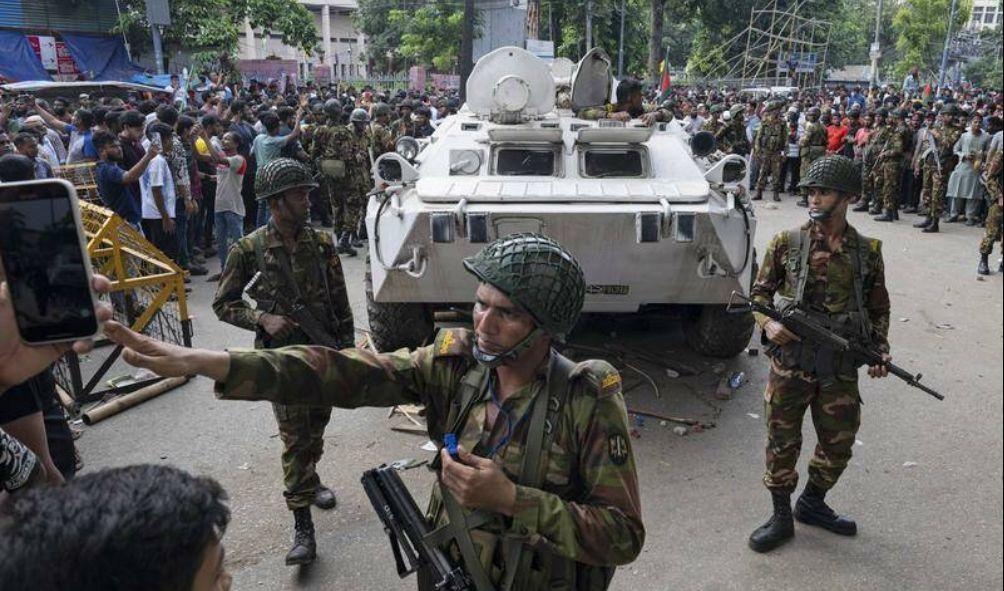
The night before Sheikh Hasina abruptly fled Bangladesh amidst intense protests, her army chief held a crucial meeting with his generals.
They decided against using force to enforce a curfew on civilians, as reported by two army officers with knowledge of the discussions.
General Waker-Uz-Zaman subsequently informed Hasina’s office that his troops would not be able to implement the lockdown she had called for, according to an Indian official briefed on the situation.
The message conveyed was unequivocal: Hasina had lost the army’s support, as detailed by the official.
This meeting and the communication to Hasina that she had lost military backing were previously unreported.
These revelations shed light on how Hasina’s 15-year tenure, marked by minimal dissent, ended abruptly and chaotically on Monday when she fled Bangladesh for India.
The nationwide curfew was declared following a deadly day of clashes on Sunday that left at least 91 people dead and hundreds injured, marking the worst day of violence since student-led protests against Hasina began in July.
Army spokesman Lt. Col. Sami Ud Dowla Chowdhury confirmed the discussions held that evening, describing them as routine updates after disturbances. He did not elaborate on the decisions made during the meeting.
Hasina could not be contacted, and her son and advisor, Sajeeb Wazed, did not respond to repeated requests for comment.
ALSO READ:
- Inside Job Exposed: Kenyan Prison Wardens Convicted for Orchestrating Daring Terrorist Escape
- Uganda Pulls the Plug: Nationwide Internet Blackout Ordered Days Before Crucial General Election
- African Elections Under the Spotlight as Zambia Turns to Kenya Ahead of 2026 Vote
- “Two Drug Barons in Cabinet?” Kenya Government Fires Back as Ex-Deputy President Sparks Explosive Drug Claims
- Kenyan Court Freezes Use of Private Lawyers by Government, Sparks Nationwide Legal Storm
Reuters interviewed ten individuals familiar with the past week’s events, including four serving army officers and two other informed sources in Bangladesh, to reconstruct the final 48 hours of Hasina’s rule. Many spoke anonymously due to the sensitive nature of the information.
Hasina, who had governed Bangladesh for 20 of the last 30 years, was re-elected for a fourth term in January following the arrest of thousands of opposition figures. Her main rivals boycotted the election.
Her tight grip on power faced challenges this summer due to protests sparked by a court decision to reserve government jobs for certain groups, which was later overturned. The protests quickly escalated into a movement demanding Hasina’s removal.
General Zaman has not publicly explained his decision to withdraw support from Hasina. However, the scale of the protests and a death toll of at least 241 made continued support untenable, according to three former senior Bangladesh army officers.
“There was a lot of unease among the troops,” said retired Brig. Gen. M. Sakhawat Hossain. “That likely pressured the chief of army staff because the troops were seeing the situation unfold.”
Zaman, related to Hasina by marriage, had shown signs of wavering support on Saturday when he addressed officers in a town hall meeting. The military later made some details of this discussion public.
The general emphasized the need to protect lives and urged patience among his officers, according to army spokesman Chowdhury.
ALSO READ: How Bangladesh Uprising Toppled Hasina’s 15-Year Rule
This was the first sign that Bangladesh’s army would not forcefully suppress the violent protests, leaving Hasina exposed.
Retired senior soldiers, including Brig. Gen. Mohammad Shahedul Anam Khan was among those who defied the curfew on Monday and took to the streets.
“We were not stopped by the army,” Khan said. “The army has done what it promised it would do.”
On Monday, the first day of the indefinite nationwide curfew, Hasina remained inside the heavily guarded Ganabhaban complex in Dhaka.
Outside, large crowds gathered as tens of thousands answered protest leaders’ call for a march to remove the leader, flooding the city center.
With the situation spiraling out of control, the 76-year-old leader decided to flee to India on Monday morning, as reported by the Indian official and two Bangladeshi nationals familiar with the situation.
Hasina and her sister, who was in Dhaka at the time, decided to leave together and departed for India around midday local time.
Indian Foreign Minister Subrahmanyam Jaishankar told parliament that New Delhi had been urging various political forces to resolve the situation through dialogue throughout July.
But as crowds defied the curfew in Dhaka on Monday, Hasina decided to resign “after a meeting with security leaders,” he added. “She requested approval to come to India on very short notice.”
A second Indian official said it was diplomatically communicated to Hasina that her stay needed to be temporary to avoid negatively affecting Delhi’s relations with the next government in Dhaka. The Ministry of External Affairs did not immediately respond to a request for comment.
Nobel laureate Muhammad Yunus, whom protesters want to lead an interim government, criticized India’s foreign policy in an interview, suggesting they had aligned with the wrong people. Yunus was not immediately available for further comment.
ALSO READ: Bangladesh PM Sheikh Hasina resigns, flees country as protesters storm palace(Video)
Later on Monday, a Bangladesh Air Force C-130 transport aircraft landed at Hindon Air Base near Delhi with Hasina on board.
She was met by Ajit Doval, India’s influential national security advisor, as reported by an Indian security official.
India had supported the creation of Bangladesh from East Pakistan in 1971. After the assassination of Hasina’s father in 1975, Hasina took refuge in India, building strong ties with the Indian political elite.
Returning to Bangladesh, she took power in 1996 and was seen as more attuned to India’s security concerns than her rivals. Her secular stance was also viewed favorably by the Hindu minority in Bangladesh.
However, resentment lingered among some retired soldiers in Bangladesh over Hasina’s safe departure.
“Personally, I believe she should not have been granted a safe passage,” said Khan, the retired soldier. “That was a mistake.”
Sheikh Hasina’s Sudden Departure: How the Army’s Withdrawal of Support Triggered Her Flight Amid Deadly Protests
